
While people with diabetes have always been the primary target for continuing glucose monitoring, today people seeking physical performance improvement or weight-loss have also found value in CGMs.
What are CGMs?
A CGM is a “system” that shares glucose levels “continuously” over multiple days. A CGM system has a sensor that includes a thin, short probe inserted into the fat tissue. The sensor “reads” glucose in the interstitial fluid. The glucose level in the interstitial fluid is similar to blood glucose with a short lag time (about 10-15 minutes).
Sensors
- When a CGM sensor is inserted, it is placing a tiny probe into the fat tissue’s interstitial fluid. After inserting a CGM sensor, the sensor must “warm-up.” During the warm-up the sensor probe is being “soaked” in the interstitial fluid to enable glucose to be tested. The user does not receive any glucose readings or alarms during the warm-up. The warm-up varies between CGMs.
- When the sensor has finished the warm-up, it will begin sending glucose data to the transmitter. The frequency of how often the sensor sends this data varies based on the CGM. The shortest frequency is once every minute; the most common is once every five minutes; and for those not concerned with hypoglycemia, the readings may only be sent once every 15 minutes in a CGM that is called a biosensor . . . yes, it’s pretty much works just like the CGM.
Transmittors
A CGM system also includes a transmitter. The transmitter receives information from the sensor and transmits it to a receiver. The receiver may be a stand-alone device, or it could be an app on a smartphone. It allows the user to view glucose changes detected by the sensor. Also, the receiver allows adding “markers” (like meals, added medication, or exercise) to the data collected. The receiver also allows the user to share glucose levels with others that the user determines. Data can be shared with parents, a spouse, the next-door neighbor, or the healthcare provider’s office. The user controls who sees the data.
Where to wear a CGM
Most CGMs are FDA approved to wear on the back of the upper arm for adults. That being said, some CGM sensors and biosensors may be worn on the abdomen / belly, or upper buttocks depending on the user’s age. You should know that your healthcare provider may say that you can wear the sensor in an alternate site and, indeed, some CGM users report wearing their CGM sensor in alternate sites with success. Please know that the manufacturer may not warranty the product if it fails while being worn in an unapproved site by the sensor manufacturer.
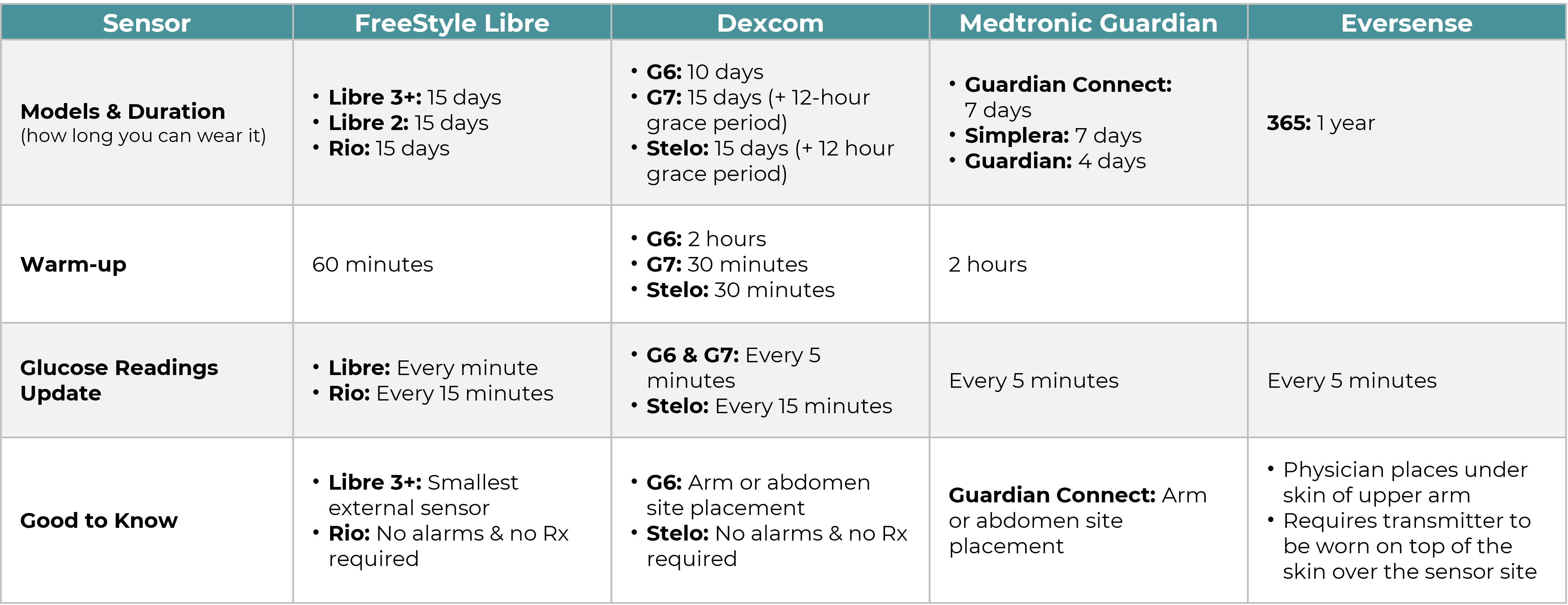
To keep things interesting, there is one CGM that is actually “implanted” into the fat-layer of the skin (in the upper arm). To implant this sensor requires the physician to make a small incision to place the sensor. The good news is this sensor is designed to last a year before requiring a replacement.
To raise your awareness of what’s available, consider this CGM Comparison Table:
Evaluating if CGMs are right for you
Yes, CGMs are impressive and can provide a lot of good useful data to the healthcare team and the individuals wearing them. But is CGM the right choice for you? Consider the following:
For people living with diabetes
- CGMs are generally recommended for people with diabetes who take glucose-lowering medications, e.g., insulin. Additionally, CGMs have proven their value to persons who frequently experience hypoglycemia (a low blood glucose) or persons who are hypoglycemia unaware (the inability to “feel” low blood glucose signs or symptoms).
- CGMs are often recommended for those whose diabetes care plans are complicated by other conditions such as pregnancy.
Blood glucose management
- There’s no one-size-fits-all in medications. CGMs can help visualize how medications are working to control blood glucose levels. CGMs allow a clearer picture of glucose and speed up getting the patient to the target glucose range.
- The longer a person lives with diabetes, the more likely that person will lose sensitivity to glucose changes. While high glucose levels may be undesirable, they are generally not thought to be emergencies. In contrast, an alarm can warn of a pending low glucose level that could become an emergency quickly.
- If finger-stick glucose numbers suggest the A1c should be one thing, but the lab value A1c shows a different reality, a CGM can usually find the reason why. Like all other body chemistry, glucose changes every minute of every day. Glucose can be affected not only by food and medication, but also the weather, stress, activity level, fluid intake, and more.
Weight loss
- A CGM can assist with weight loss by providing real-time feedback on how different foods raise blood glucose levels. When glucose levels are higher, the body produces more insulin to bring that glucose back down to a better level. High insulin levels slow down weight-loss.
- A CGM can assist with weight-loss by providing information to optimize the diet and physical activity to support your body’s nutritional needs and your weight loss goals.
Healthy habits
- While the carbohydrate count in food may be the same, that food’s composition could affect it’s absorption in the digestive system. Additionally, a food that makes one person’s glucose go high may have little effect on another’s. This is confusing to patients but a genuine reality. CGMs can help the person with diabetes learn the unique foods that have an exaggerated glucose response and those that have a blunted glucose response.
- CGMs are not meant to be worn like a weapon and “control” your behavior. A CGM is a source of data. It is not an extension of the “Diabetes Police.” The alarms are designed to be individualized to alert you when you want to know if the glucose is outside a safe range. Alarms can be turned off when desired except for a severe low alarm (again, because low glucose can be an emergency).
- A CGM is also finding a place in physical training. Monitoring the availability of “fuel” (alias, glucose) can impact final performance outcome. It’s sort of a secret weapon in competitive athletics.
The reality of CGMs
With a little professional guidance, CGMs can provide a wealth of good, usable information. Most CGM users find them very helpful. It should be known, that just like cell phones sometimes misbehave, sometimes a CGM will misbehave also — so you may still stick your finger sometimes to verify the sensor.
If you have questions about a CGM system, reaching out to that CGM’s customer service is usually the best resource. Regretfully, the process may take a little time (while on hold), but the information shared is up-to-date and correct. Also, if the sensor malfunctions or “fails,” customer service will assist in replacing that sensor.
The decision to use a continuous glucose monitoring system is best decided by a patient and their provider. Also, consider which, if any, CGM system your third-party payer may “prefer” and pay the most toward. Keep in mind that some third-party payers consider CGMs a pharmacy benefit and others a medical / durable medical equipment benefit.
Continuous glucose monitors are associated with reducing low glucose emergencies and providing helpful information to the user. If you try one and don’t like it, you don’t have to wear it again. I predict that you’ll find it more than a little bit interesting.